Burr oak acorns contain less than 1% tannins — the lowest of any North American oak species. Indigenous communities ground them into flour for centuries. That’s interesting if you’re foraging. But if you’re planting a large shade tree in Utah’s bone-dry climate, here’s what actually matters: this tree has survived droughts that have killed entire orchards across the Intermountain West.
Utah is the second-driest state in the US. Salt Lake City’s water rates climbed over 35% between 2019 and 2026. Planting the wrong tree — one that demands 20 gallons per week through August — is a real financial mistake that plays out slowly over years, not all at once.
Burr oak (Quercus macrocarpa) gets recommended constantly on Utah gardening forums and by extension offices. Whether that recommendation holds up under scrutiny is a different question.
Why Burr Oak Actually Earns Its Waterwise Reputation
Most “waterwise” tree claims are marketing. This one has a physiological basis.
The Root System Makes the Difference
Burr oak develops one of the deepest taproot systems of any deciduous tree in North America. Young trees — even 1-gallon nursery stock — will push a taproot 4 to 5 feet deep in the first growing season before putting much energy into visible canopy growth. This frustrates homeowners expecting fast top growth. It shouldn’t.
That deep root architecture lets the tree access soil moisture during surface droughts that would stress or kill maples, ashes, and ornamental pears. Once established — typically 3 to 5 years after planting — burr oaks in Utah can often survive on natural precipitation alone in average snowpack years. In genuine drought years, supplemental irrigation every two to three weeks through the hottest months keeps them thriving. That’s a fraction of what a red maple or a honeylocust demands.
Soil Tolerance in Utah’s Alkaline Landscape
Utah soils are frequently alkaline. pH 7.5 to 8.5 is common along the Wasatch Front. Most oaks hate alkaline soil — they develop iron chlorosis (yellowing leaves from nutrient lockout) within a few seasons and slowly decline.
Burr oak is genuinely more tolerant of high pH than most oak species. It’s native to the Great Plains, where alkaline, heavy clay soils are the norm. It doesn’t thrive at pH 8.5+, but it handles the 7.5 to 8.0 range that defeats red oaks and pin oaks without requiring sulfur amendments. That alone makes it practical where those other species aren’t.
Heat and Cold: Utah’s USDA Zones 4–7
Utah spans USDA hardiness zones 4 through 9, depending on elevation. Most of the populated Wasatch Front sits in zones 5 to 7. Burr oak is rated hardy to zone 3 and tolerates zone 8 heat without stress. That coverage is unusually broad for a large deciduous tree.
Compare that to the increasingly popular Chinese pistache (Pistacia chinensis), which struggles at zone 6 in bad winters, or the Chanticleer pear, which routinely winter-kills at higher elevations. Burr oak doesn’t have those cold-edge vulnerabilities. It was built for continental extremes.
Burr Oak Size and Growth Rate: The Honest Numbers
Here’s the comparison that actually helps you decide.
| Tree Species | Mature Height | Mature Spread | Growth Rate (per year) | Water Need (established) | Utah pH Tolerance |
|---|---|---|---|---|---|
| Burr Oak (Q. macrocarpa) | 60–80 ft | 60–80 ft | 12–15 inches | Low | Up to pH 8.0 |
| Gambel Oak (Q. gambelii) | 20–35 ft | 15–25 ft | 6–10 inches | Very Low | Up to pH 8.2 |
| Chinkapin Oak (Q. muehlenbergii) | 40–60 ft | 40–60 ft | 13–18 inches | Low–Medium | Up to pH 7.8 |
| Red Maple (Acer rubrum) | 40–70 ft | 30–50 ft | 24–36 inches | Medium–High | Up to pH 6.5 |
| Thornless Honeylocust (Gleditsia triacanthos inermis) | 30–70 ft | 30–70 ft | 18–24 inches | Low–Medium | Up to pH 8.5 |
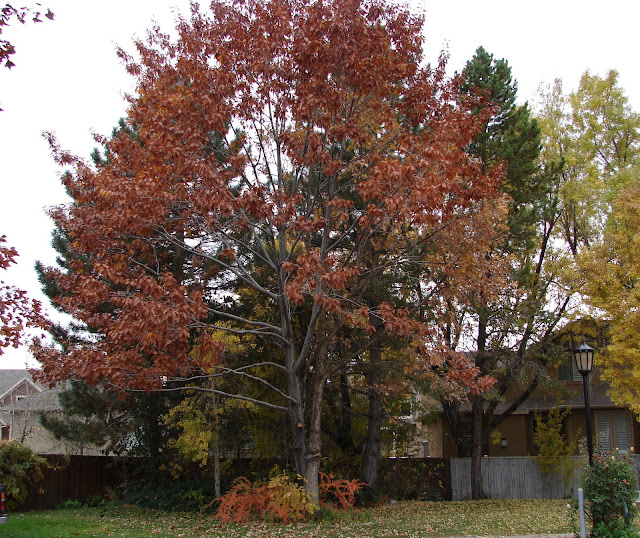
Burr oak is genuinely large. At maturity, you’re looking at a 60 to 80 foot tall tree with an equally wide canopy. Cathedral-scale. It will eventually shade your entire front yard, your neighbor’s yard, and possibly part of the street. A 15-foot setback from foundations is the absolute minimum; 25 feet is more realistic for long-term peace of mind.
Growth rate is the honest sticking point. Twelve to fifteen inches per year is not fast. A burr oak planted today won’t provide meaningful shade for 8 to 10 years. If you want a tree that looks substantial in 3 to 4 years, honeylocust or Chinese pistache will serve you better.
Bottom Line: Burr oak is the right call if you’re planting for your property’s 30-year future. It is categorically the wrong call if you want shade by your next outdoor party season.
The Acorn Problem Is Real — Plan for It
A mature burr oak drops thousands of large acorns — each one an inch or more in diameter — every fall. They’re not like the small pellets from a pin oak. They’re big enough to become a slip hazard on paved surfaces, and dense enough that a riding mower sounds like it’s digesting gravel. If the canopy will hang over a driveway, patio, or play area, this is a genuine management problem, not a minor seasonal inconvenience. Yes, the acorns are edible and low in bitterness — but “you can eat them” is not a maintenance strategy.
How to Plant Burr Oak in Utah: Four Steps That Matter
Most establishment failures trace back to a small number of predictable mistakes. Here’s what Utah extension research and nursery experience actually supports.
- Buy small — not large specimen stock. Moon Valley Nurseries and Western Garden Nurseries both sell large, pre-grown specimen oaks. They look impressive at the nursery and perform worse in Utah than a 5-gallon or bare-root tree planted properly. Burr oak’s taproot doesn’t transplant well once established. A smaller tree with less root disruption will outgrow a large transplant within five years. This is not speculation — it’s documented in transplant stress research from Utah State University.
- Dig wide, not deep. Two to three times as wide as the root ball, but never deeper than the root ball itself. Plant high — the root flare should sit 1 to 2 inches above final grade. Utah’s clay soils compact and drain poorly; planting too deep effectively drowns the crown over time.
- Skip the amended backfill. Every garden center will try to sell you a soil amendment to mix into the planting hole. The research is clear: amending the backfill creates a soil interface that discourages roots from expanding into native soil. Fill the hole with the native soil you dug out. If you want to amend, do it across a wide area around the planting zone — not inside the hole.
- Water deep and infrequently from day one. During the first two growing seasons, water to a depth of 24 to 30 inches every 10 to 14 days — not every few days. This trains the root system to grow deep rather than staying shallow. A soil probe is the most reliable way to confirm depth of moisture penetration. Mixing Espoma Bio-tone Starter Plus into the top layer at planting adds mycorrhizal fungi that genuinely help oak establishment — that’s one product worth the cost.
Best Planting Window in Utah
Fall planting — mid-September through October — is the top choice. Soil temperatures stay warm enough to promote root growth, but air temperatures drop enough to reduce transplant stress. Spring planting, from March through April before bud break, is a solid second option. Summer planting is a gamble that rarely pays off with oaks.
Mulch Is Not Optional
A 3 to 4 inch layer of wood chip mulch extending to the drip line — kept 6 inches back from the trunk itself — is the highest-return investment you can make in a newly planted oak. It moderates soil temperature, retains moisture, and gradually improves the soil as it breaks down. Skip decorative rock entirely. Rock mulch raises soil surface temperatures in Utah summers to levels that actively harm the shallow feeder roots that sustain a young tree through establishment.
Burr Oak vs. Other Large Utah Trees
Is Gambel Oak Better for Smaller Properties?
Gambel oak (Quercus gambelii) is Utah’s native oak and the most drought-tolerant option in this comparison. But it’s a terrible choice for a formal lawn tree. It spreads aggressively by root suckers into adjacent turf, resists training to a single trunk, and reaches a mature form that’s irregular and shrubby rather than canopy-shaped. If you’re naturalizing a slope or a large back acreage, Gambel oak wins. For a formal front yard shade tree, it loses badly to burr oak.
Chinkapin Oak: The Underrated Middle Option
Chinkapin oak (Quercus muehlenbergii) is worth serious consideration if burr oak’s eventual scale feels like too much for your site. It reaches 40 to 60 feet, grows slightly faster than burr oak, tolerates alkaline soils reasonably well (up to pH 7.8), and carries a more refined leaf shape. Millcreek Gardens in Salt Lake City typically stocks chinkapin oak, and it’s worth asking about specifically. The honest comparison: chinkapin oak is the better pick for a standard 6,000-square-foot suburban lot. Burr oak belongs in parks, estate lots, and anywhere you’re planting with a 50-year horizon in mind.
Bottom Line: For most Utah residential properties, chinkapin oak hits the balance point more realistically. Burr oak is a generational decision, not a landscaping decision.
When Burr Oak Is the Wrong Tree for Your Situation
Does it work on small urban lots?
No. A tree that reaches 60 to 80 feet with equivalent canopy spread does not belong on a 50×100-foot city lot in Salt Lake City, Murray, or Provo. The roots will eventually conflict with utilities and neighboring properties, and the acorn volume near any paved surface is simply unmanageable at maturity. For urban lots, look at the Accolade elm (Ulmus ‘Morton’) — around 70 feet tall but with a more contained 40-foot spread — or the Princeton elm (Ulmus americana ‘Princeton’). Both are Dutch elm disease-resistant, faster-growing, and far more manageable near structures than a full-grown burr oak.
What if my soil tests above pH 8.0?
Get a soil test first. The USU Extension Analytical Laboratory in Logan charges $17 for a basic soil panel that includes pH. If your result comes back above 8.0, burr oak will develop chlorosis despite its relative tolerance, and you’ll be fighting that problem with repeated sulfur applications for years. At that pH, thornless honeylocust (Gleditsia triacanthos var. inermis) handles conditions better than any oak and gives you a large, fast-growing, low-water shade canopy without the chlorosis management burden.
Is the slow growth rate a dealbreaker?
For most people, yes — and that’s an honest answer, not a dismissal. Twelve to fifteen inches per year means a 5-gallon nursery tree won’t provide meaningful canopy shade for a decade. If you need shade in five years, plant a honeylocust or a hackberry (Celtis occidentalis) for immediate impact, and plant a burr oak alongside it as the long-term replacement. That two-tree strategy isn’t a workaround — experienced Utah landscapers use it routinely.
The person who planted a burr oak in the early 1990s and had the patience to wait is now sitting under a magnificent, self-sufficient tree that hasn’t needed regular supplemental irrigation in over two decades. That’s exactly the scenario Utah’s tightening water future demands more of. Whether a 30-year timeline fits your life right now is the only question left to answer.
This is not financial advice. Tree planting decisions involve site-specific variables no general article can fully account for — consult a certified arborist or your local USU Extension office before committing to a large-scale planting.