Most Utah gardeners treat October like it’s already too late to put anything in the ground. For garlic, that assumption costs you an entire summer harvest. Garlic is not a spring vegetable — not here, not anywhere with a real winter. The October planting window exists because of plant biology, not gardening tradition. Miss it and you wait twelve months to try again.
Garlic planted in spring in Utah gets perhaps 3–4 weeks of cold before the soil warms too fast. That’s not enough. Planted in fall, it gets the full winter — exactly what it needs.
This is not professional agricultural advice. Frost dates vary by elevation, microclimate, and year. Verify your specific planting window with the Utah State University Extension office before committing your seed garlic budget.
Why October Is the Critical Planting Window in Utah
Garlic doesn’t grow from seed. Each clove is a miniature plant waiting for a specific biological signal to produce a full bulb. That signal is sustained cold — a process called vernalization.
Here’s what vernalization actually does: garlic exposed to temperatures between 32°F and 50°F for a minimum of 4–6 weeks activates lateral bud formation inside the bulb. That’s what creates individual cloves. Skip that cold period and the plant grows as a single undivided mass — something resembling a small round onion with no cloves worth separating or cooking with.
Fall planting solves this automatically. Cloves go in the ground, develop roots before the soil freezes, then sit dormant through winter while accumulating exactly the cold hours they need. By spring, they’re primed to grow fast and form large bulbs before summer heat shuts down development. Utah’s winters do the work for you.
Planting in March fails in Utah because the ground warms before vernalization can complete. You might get partial bulb formation, but clove separation is poor. The plant grows — it just doesn’t produce anything useful. You’re not fighting Utah’s winters. You’re relying on them.
Utah’s First Frost Dates and Recommended Planting Windows by Region
Utah spans USDA hardiness zones 4a through 9a, so the October window shifts by location. The target: plant 4–6 weeks before your ground freezes hard, meaning sustained temperatures below 25°F.
| Region | Avg. First Frost | Hard Freeze Onset | Target Planting Window |
|---|---|---|---|
| Logan / Cache Valley (Zone 5b–6a) | Oct 5–10 | Late October | Sept 20 – Oct 10 |
| Salt Lake City / Wasatch Front (Zone 7a) | Oct 15–22 | Early November | Oct 1 – Oct 20 |
| Provo / Utah Valley (Zone 6b–7a) | Oct 12–20 | Early November | Oct 1 – Oct 18 |
| Moab (Zone 7b–8a) | Oct 25 – Nov 5 | Mid-November | Oct 10 – Oct 30 |
| St. George (Zone 8b–9a) | Nov 15 – Dec 1 | Mid-December | Oct 25 – Nov 15 |
Elevation complicates everything in Utah. A garden at 5,500 feet near Heber City behaves more like Logan than Salt Lake City, even if it sits geographically close to the Wasatch Front. When in doubt, plant earlier rather than later — garlic planted two weeks early suffers less than garlic planted two weeks late.
The Soil Temperature Threshold That Actually Matters
Air frost dates get most of the attention, but soil temperature governs garlic root development. Roots grow actively when soil sits between 50°F and 65°F. Below 40°F, root growth slows significantly. Below 32°F, it stops entirely.
The practical implication: you want cloves to establish a root system before soil temperature drops below 40°F. That’s why the 4–6 week rule exists — it’s buying time for roots, not just getting cloves buried. A clove with an established root ball going into winter is far more resistant to frost heaving and rot than a bare clove sitting in cold soil with nothing anchoring it.
Hardneck or Softneck: Utah’s Climate Picks a Side
There are two primary garlic types. This decision matters more than any other in the planning process, and most of Utah’s climate answers it before you even open a seed catalog.
| Feature | Hardneck | Softneck |
|---|---|---|
| Cold hardiness | Zones 3–7 (optimal) | Zones 6–9 (prefers mild winters) |
| Cloves per bulb | 4–12, fewer and larger | 12–20, more and smaller |
| Storage life | 4–6 months | 8–12 months |
| Flavor profile | Complex, often sharp | Mild, consistent |
| Produces scapes | Yes — edible bonus | No |
| Best for Utah | Northern and Central Utah | Southern Utah only |
Hardneck Varieties That Perform in Northern and Central Utah
For Salt Lake City, Logan, Provo, and anywhere on the Wasatch Front, hardneck is the correct choice. Cold winters give hardneck varieties the full vernalization window they need to produce well-separated, large-cloved bulbs.
- Music (Porcelain hardneck): The most reliable performer for Utah home growers. Large bulbs with 4–6 cloves, stores up to 6 months. Available from Territorial Seed Company at roughly $18–22 per quarter-pound. Performs consistently in Zones 5–7 and handles Utah’s temperature swings without complaint.
- Romanian Red (Porcelain hardneck): Similar bulb size to Music with a sharper, more complex heat profile. Handles late-winter temperature variability along the Wasatch Front better than most Rocambole types, which makes it a practical backup if you want more than one variety.
- German Red (Rocambole hardneck): Better flavor than any Porcelain variety — richer, more layered, the kind of garlic that actually tastes like garlic in a blind test. Shorter storage at 4–5 months. Available through High Mowing Organic Seeds at around $16 per quarter-pound. Best suited to the colder end of the Utah spectrum: Logan, Park City, high-elevation Wasatch locations.
- Chesnok Red (Purple Stripe hardneck): Medium cloves with an excellent roasting flavor that doesn’t turn bland with heat. Handles late spring temperature increases better than most hardneck types, which matters as Utah warms quickly in May and June while bulbs are still sizing up.
Rocambole types like German Red and Spanish Roja consistently outperform other varieties in taste comparisons, but they have the shortest shelf life and need the coldest winters. If you’re cooking directly from the garden and not planning to store for months, the flavor difference is real and worth the tradeoff. If you need garlic through January, stick with Porcelain types.
Softneck Options for Southern Utah
The St. George corridor and lower-elevation Moab areas don’t get cold enough, reliably, to fully vernalize hardneck types. Winters are too mild for consistent clove formation. Softneck artichoke varieties are the practical answer for Zone 8 and above.
- Inchelium Red (Artichoke softneck): Mild flavor, stores 8–9 months, adapts to a wide temperature range without complaint. Available through Southern Exposure Seed Exchange for $14–18 per quarter-pound. The lowest-risk starting point for Zone 8+ Utah growers who want a confirmed performer.
- Lorz Italian (Artichoke softneck): One of the oldest American garlic varieties, documented in Pacific Northwest gardens for over a century. Produces larger-than-average bulbs for a softneck type and handles end-of-season heat well — useful in St. George where spring ends abruptly.
Bottom Line: North of Provo, buy hardneck. Music and Romanian Red for consistency; German Red if you want better flavor and will use it within five months. South of Moab, Inchelium Red softneck is your baseline. The Moab corridor (Zone 7b–8a) is borderline — Porcelain hardnecks like Music tolerate that zone better than Rocambole types if you want to try hardneck there.
How to Plant Garlic in Utah: The Numbers That Actually Matter
Vague guides say to plant garlic “a few inches deep.” Here is what that means in measurable terms:
- Prepare the soil before anything else. Garlic needs loose, well-draining soil at pH 6.0–7.0. Work 2–3 inches of finished compost into the top 8–10 inches. Clay-heavy soil is common along the Wasatch Front — if standing water takes more than 30 minutes to drain after watering, mix coarse perlite into the top layer before planting. Compacted clay produces stunted bulbs with poor clove separation, regardless of how well everything else is done.
- Add phosphorus at planting time. Garlic’s fall job is root development, and phosphorus is the nutrient that drives it. Dr. Earth Organic 5 Fertilizer (NPK 4-6-3, roughly $20 for 4 lbs) worked into the planting bed gives roots what they need through dormancy. Bone meal is a cheaper alternative — apply at 10 lbs per 100 square feet and work it into the top 6 inches.
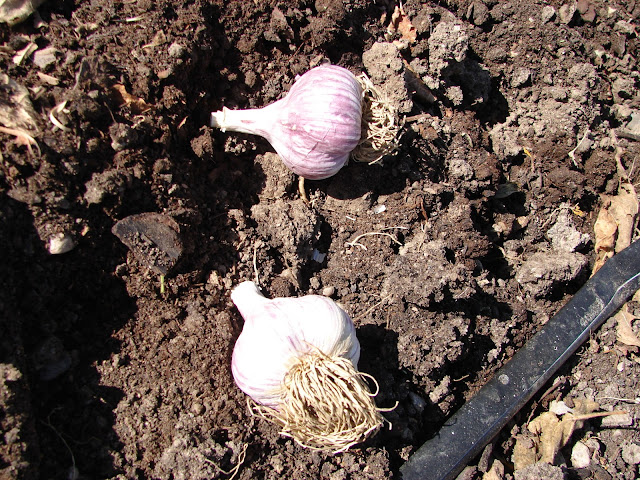
- Break bulbs into cloves the day you plant. Separating them days in advance increases rot risk at the exposed cut surface. Select the largest outer cloves from each bulb. Clove size and final bulb size are directly correlated — smaller inner cloves belong in tonight’s dinner, not in the garden bed.
One point on sourcing: grocery store garlic is often treated with sprout inhibitors that delay or prevent emergence. It may also carry fungal issues from commercial production, and there is no way to know its variety, cold hardiness rating, or growing origin. Buying seed garlic from a dedicated supplier — Territorial Seed Company, High Mowing Organic Seeds, or Keene Organics — gives you known varieties, published cold hardiness zones, and untreated bulbs. The price difference over store garlic is small per clove and significant in terms of outcome.
- Plant each clove exactly 2 inches deep, pointy end up. One inch is too shallow — Utah’s freeze-thaw cycles in late winter physically eject unprotected cloves from the soil. Four inches is too deep — spring emergence takes longer and burns stored energy. Two inches. Measure it the first time if you’re not confident what that looks like in your hand.
- Space cloves 6 inches apart within rows. Space rows 12 inches apart. Closer spacing gives more plants but smaller bulbs. If you want large heads for cooking — and you do — do not crowd them. The math is simple: more space per clove equals more resources per bulb.
- Water in immediately after planting. Moist soil through the planting depth, not saturated. One thorough watering is sufficient unless the following week turns unusually dry.
Label each variety row at planting time with a weatherproof marker on a stake. Music and German Red are identical as green shoots in March. Knowing which row outperformed in your specific microclimate tells you what to reorder the following September.
Mulching After Planting Is Not Optional in Utah
Apply 4–6 inches of straw mulch after the first hard freeze. That is the full instruction. Utah’s late-winter freeze-thaw pattern — repeated swings between 15°F and 45°F from January through March — physically ejects shallow-planted cloves from the soil. Mulch stabilizes ground temperature and prevents that mechanical damage. Skipping mulch is the single most common reason Utah garlic beds fail to produce, even when planting timing, depth, and variety were all correct. Straw, shredded leaves, and wood chips all work. Fresh grass clippings do not — they mat down, restrict airflow, and trap moisture directly against the soil surface where it encourages rot.
What to Expect from Planting Through Harvest
Will green shoots appear before winter?
Yes — often within 2–4 weeks of planting if October temperatures stay mild. Small green shoots emerging before the first hard frost are completely normal. When temperatures drop hard, the above-ground growth dies back or disappears. The root system below the mulch remains alive. The plant is dormant, not dead. Do not dig it up to check. In Salt Lake City, expect re-emergence starting in late February or early March, depending on the year. Logan typically sees it a few weeks later.
What if winter turns out to be unusually cold?
Standard hardneck varieties — Music, Romanian Red, German Red — are rated cold-hardy to Zone 4 or 5. A harsh Utah winter should not kill properly planted, mulched garlic on the Wasatch Front or in Cache Valley. The real risk is mechanical: no mulch plus severe freeze-thaw plus shallow planting equals cloves pushed out of the ground by February. If you’re gardening above 6,000 feet or on a north-facing slope with no windbreak, add an extra inch of mulch beyond the standard recommendation and plant at 2.5 inches rather than 2. Keene Organics publishes cold tolerance notes for each variety they sell — useful for high-elevation Utah growers trying to narrow down the right seed garlic for genuinely marginal conditions.
When does Utah garlic actually get harvested?
Late June to mid-July for most of the Wasatch Front. The calendar date is a rough frame — the plant tells you when it’s ready. When roughly half the lower leaves have turned brown while the upper leaves remain green, the bulb is fully formed. Dig one plant and check: cloves should be firm, distinct, and filling the wrapper completely. Harvest too early and cloves are underdeveloped. Harvest too late and the outer wrapper splits, which cuts storage life from six months down to two or three.
Hardneck varieties produce scapes in early June — curled green flower stalks that emerge from the center of each plant. Cut them when they complete their first full curl. This redirects the plant’s energy from seed production into bulb development and meaningfully increases final bulb size. The scapes are fully edible: mild garlic flavor, excellent in stir-fries, pestos, or sautéed simply with olive oil and salt.